
What Simpson County Deed Records Show
The Simpson County Chancery Clerk records the instruments that affect land here. The books hold deeds, deeds of trust, authorities to cancel, liens, judgments, oil and gas orders, and some real-estate UCC filings. Each type does different work. A deed conveys an interest. A deed of trust secures a debt. A cancellation or release ends a recorded claim. Sharing one index does not make them the same legal event. Read each instrument for what it actually does.
| Deed Type | What It Does | Common Use |
|---|---|---|
| Warranty deed | Conveys the stated interest with deed warranties | A conventional sale or transfer |
| Quitclaim deed | Conveys whatever interest the grantor has, if any | Interest cleanup or a family transfer |
| Corrective deed | Corrects stated facts in an earlier instrument | Name or legal-description correction |
| Executor or trustee deed | Records a transfer by an authorized fiduciary | Estate, trust, or trustee action |
| Tax deed | Records a later step in the tax-sale process | Research following delinquent taxes |
Always read the full instrument before classifying it. A grantee name alone tells you nothing about reservations, survivorship terms, easements, or the exact land conveyed. An index entry proves only that an item was indexed, never that the title is clear.
Search Simpson County's Delta Index
The county links to the Delta deeds and records search. It takes grantor and grantee names in last-first order. You can also query by book and page. Filing-date ranges work too. So do instrument number, legal-description terms, subdivision/block/lot, and Section/Township/Range. Optional controls cover party role plus numeric or date ranges. The full instrument-type list is not published. Work only with the filters visible in a live session.
| Search control | Best use | What to retain |
|---|---|---|
| Grantor or grantee | Following parties through transfers | Spelling, suffix, and party role |
| Book and page | Opening an assessor cross-reference | Both values exactly |
| Instrument number | Returning to one indexed filing | Number and filing date |
| Subdivision or section data | Narrowing a tract | Lot/block or township/range/section |
The Delta access page shows its subscription and pay-per-document choices.
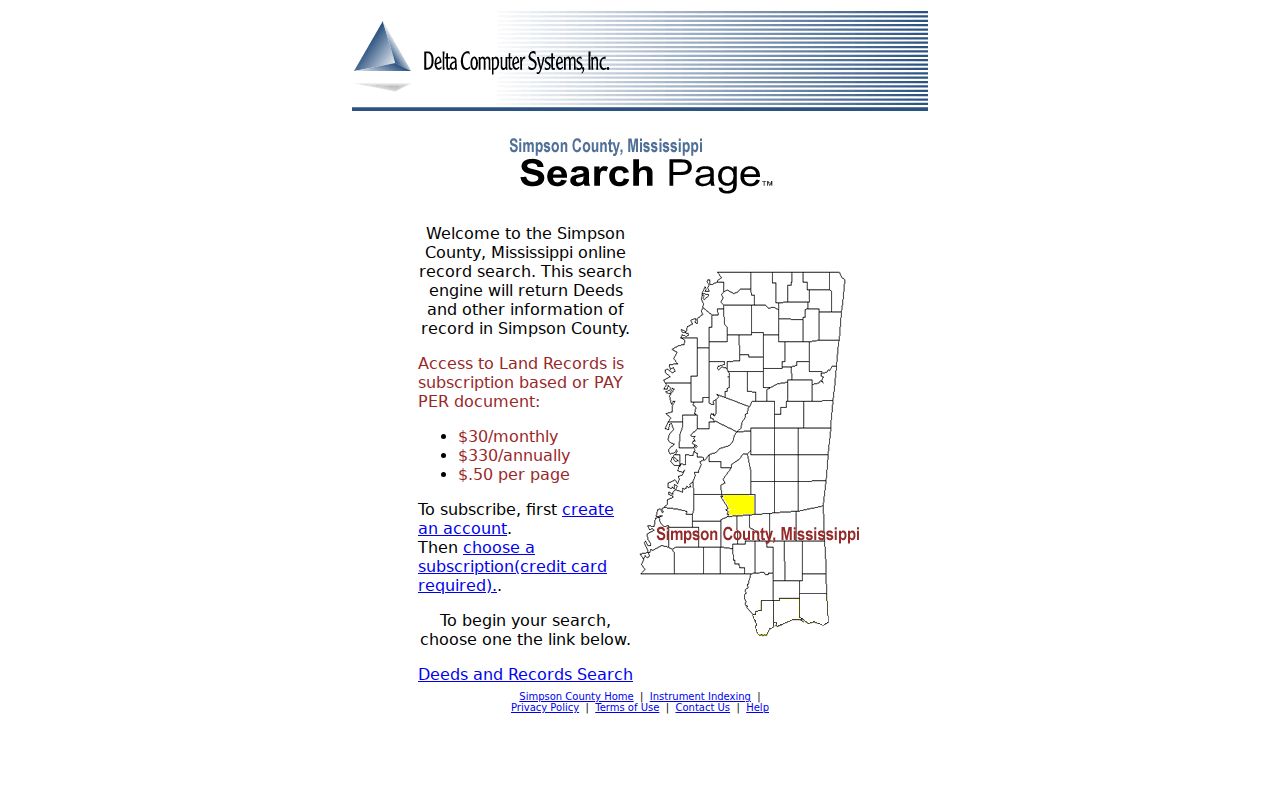
Searching the index costs nothing. Document images carry a separate charge, so confirm the current price before purchase and keep office-copy fees separate.
Connect the Assessor to Simpson Deeds
The Simpson appraisal search lists DEED BK and DEED PG beside PPIN, PARID, OWNER, ADDRESS, and LEGAL 1. Those book and page fields are the bridge into deed records. Once you pull the instrument, compare the legal description and the named parties. One caution applies. The tax-roll OWNER field and the newest deed grantee do not always match. A transfer recorded after January 1 may still show the prior owner of record on the roll. That follows Mississippi appraisal guidance for the assessment cycle.
The assessor does not publish a stated refresh interval for the portal. So treat the roll as a snapshot of the January 1 owner rather than a live deed feed.
Follow Simpson County Grantors and Grantees
Start with the newest reliable deed reference. That document gives you the grantee and the complete legal description. From there, search the named grantor's earlier acquisition and repeat the process back through time. Run a forward search too. Releases, assignments, corrective deeds, and later conveyances can all change the story.
- Find the most recent candidate instrument by book/page, instrument number, or grantee.
- Read the deed and capture its grantor, grantee, dates, and full land description.
- Search the grantor as a prior grantee and match the same tract.
- Repeat, while logging corrections, estate instruments, releases, and gaps.
- Grantor
- The party transferring the stated interest.
- Grantee
- The party receiving the stated interest.
- Chain of title
- The ordered sequence of instruments tied to the same land.
- Book/page and instrument number
- Different references used to locate a recorded item.
Party labels behave differently in assignments, releases, trustee deeds, and corrections. Confirm what the document text actually says rather than treating every hit as a sale.
Older Simpson County Deed Books
The online index does not state its earliest year or full historic coverage. Older Simpson County deed records need a fallback chain. FamilySearch's county catalog lists deed books from 1825 through 1910. It also lists grant books from 1854 through 1929 plus a 1967 volume, and indexes spanning 1825 through 1968. Viewing images may require an account or a FamilySearch Center visit. The Mississippi Department of Archives and History also keeps local-government finding aids. It holds historic court material as well. Its Simpson finding aid confirms land records, indentures, and deeds with 1834 material. Treat these as archive leads rather than a promise that every image can be downloaded.
Note: Preserve a volume title, year span, image restriction, and whether the source is an index, microfilm, or original book.
The 1830s Simpson Plat Trail
A FamilySearch catalog for a Simpson plat book dates the material to 1832 through 1842. It also describes township-and-range coverage with an index. The source microfilm traces back to the Simpson County Courthouse. That makes it a strong lead for old survey geography. Deeds sometimes lean on it instead of a modern road address. A catalog entry is not the plat itself, though. Obtain the image under the catalog's access rules. Then reconcile its section, township, range, and lot calls with later deeds and recorded plats. This historic geography is especially valuable for rural land. Community names there have shifted over time.
Simpson County Liens and Releases
Deed research should continue past deeds when the question involves an encumbrance. The Chancery Clerk indexes deeds of trust, authorities to cancel, judgments, liens, oil and gas orders, and lis pendens notices. It also indexes some real-estate UCC transactions. Know what each filing is. A lis pendens is notice of litigation, not a final judgment. A deed of trust is security, not a conveyance of ordinary ownership. Match every filing to the parcel description. Then hunt for its release, cancellation, assignment, or disposition. The statewide tax-lien registry covers state liens after the 2015 transition. A statewide name result does not by itself attach a lien to any one Simpson County parcel.
Request a Simpson County Deed Copy
The Land Records Division sits at 111 W Pine Ave in Mendenhall and opens its deed records for public inspection weekdays from 8 a.m. to 5 p.m. Copies are cheap. The county charges $0.25 per page for self-service copies and $0.50 per page when staff make them, plus a certification fee. Recording happens as documents arrive, and most recorded deeds are viewable the same day once processing finishes.
Mail works too. Describe the deed as precisely as you can, enclose a check or money order payable to the Simpson County Chancery Clerk, and add a stamped self-addressed envelope. Send everything to PO Box 367, Mendenhall, MS 39114. Unsure how many pages you need certified? Call 601-847-2626 for help.
Recorded, not guaranteed. Simpson County deed records show filed instruments. They do not resolve every defect, unrecorded interest, or competing claim.
Keep the certification, the stamped response date, and any attached pages together with your deed copy. Exhibits matter. An easement, a correction, a reservation, or an extended legal description often carries over onto a page the main document merely references. So read each prior instrument named in the text. When the job is a full chain of title in Simpson County rather than a single recorded deed, the work goes transfer by transfer. The former owners workflow walks each linked transfer from one owner of record to the next.